Tuesday, October 10, 2017

The Spiritual Carnot Cycle

The spiritual Carnot cycle converts spiritual power into God’s work on earth. Every engineer who has completed a thermodynamics class has learned about thermodynamic cycles of engines that convert heat into mechanical work, for example the Carnot cycle, the Brayton cycle, the Otto cycle, and the Rankine cycle. What is the spiritual Carnot cycle?
  • A person at a low state of spirituality enters this cycle when he begins to sense the workings of the Holy Spirit in his life, revealing God’s real presence, nature, and character, drawing that person into a closer relationship. The individual’s spiritual fervor begins to increase. 
  • As it continues, a spiritual high point is achieved, not in a pejorative sense of inebriation, but a sense of joy and exhilaration in the Lord’s manifest presence. This spiritual mountaintop brings new wonders of the heavenlies, and amazing answers to prayer, increasing and continuing closeness of the believer to the Lord. 
  • The next phase begins when the Lord begins to withdraw the sense of His presence. The believer continues in fervent faith, not slowing in behaviors associated with the manifest presence of the Lord. As he works for the Lord, the fruit is still there but not the sense of His presence. The believer must labor in faith. God’s kingdom is built.
  • This phase transitions gradually to the final phase of spiritual deflation, called desolation by Ignatius. All sense of God’s presence and power have vanished. The believer reflects wistfully on how wonderful it once was, and wonders if God’s presence will ever return. Ignatius offered several guidelines for this phase. At some point, God begins to work again, and the cycle starts anew. 

There are two aspects of work accomplished during this cycle. Firstly, God’s power is manifested in the presence of unbelievers when the believer speaks and acts in faith. This is all the more powerful when the believer acts knowing what the Lord calls him to, but without sensing His presence. God’s kingdom is built and He is glorified in the world, and enters the lives of those living without Him. Secondly, the believer learns more of God’s nature and character in the contrast of the phases. He desires to become and be more like God, and learns how dependent he is on a God for even the simplest aspect of godliness. 

The unspiritual Carnot cycle accomplishes exactly the opposite. Without diving into detail, it involves people taking their needs (food, housing, medical problems) to the government. The government provides, resulting both in glorification of human institutions, and codependency between individuals and government. There is no spiritual growth, but the reverse. 


The work of spiritual cycles is not some mystical, mysterious secret. God exhibited His plan in plain sight for all of recorded history. Doubters may whine about God’s unfairness, but He is being gracious in revealing His ways. Although our actions should always exhibit the fruit of the Spirit, our spiritual walk will be stronger as we recognize and cooperate with the Lord, in the way He chooses to deal with us.

Monday, September 25, 2017

The Storm of God's Grace

In Genesis 9:11 & 15, God promised He would never again destroy the world by flood. But that doesn't mean there won’t be storms. The rainbow is His sign that He will not wipe out all mankind by a flood.

The story of Paul’s voyage to Rome (Acts 27) illustrates how bad these storms of life can be. Millennia before global warming triggered frequent superstorms, he spent two weeks with 275 of his closest friends trapped inside a violent storm on a ship as a Roman prisoner. Taking this as a type of a storm of life, perhaps we can learn a bit about God’s dealings with us.

Paul knew the danger and warned the centurion and ship’s captain. However, the professional sailor dissed Paul’s advice and sailed into the storm. (Acts 27:11) At first, they thought they had succeeded. (27:13) But God does not suffer fools to persist long in their self-centered delusions. (27:14)

Recognizing their plight, they began to throw cargo overboard. (27:18) Everyone, regardless of their spiritual condition, knows that dire circumstances require us to shed the less important to get or keep the most important. Why does it take a life-threatening storm for us to remember this?

God was with Paul and all those on board through the storm. He sent an angel to encourage Paul (27:23-24). Paul responded by encouraging everyone on board with a strong statement of faith. (27:25) The angel noted that God had granted Paul the life of all of his traveling companions - even his Roman captors. What a blessing to be able to speak words of life and hope to the unbelievers and desperate around us! Perhaps they will only hear us if we experience the storms of life together.

The sailors wanted to abandon their posts, but were thwarted by Paul and the Roman soldiers. (27:30-32) Lest we condemn these sailors too harshly, how many of us have been tempted to flee tough circumstances, to take the easy way out? But that is not how God works. He forms and refines us in the midst of the fire. There is a gospel song by the Speers about Daniel’s three friends in the fiery furnace, that ends with the chorus, “...He’s still in the fire.” Daniel’s friends were delivered from it, but the Fourth Man did not come out. That’s where God works. Our bonds are consumed and we are set free; He is there with us. God’s Grace even deals with pagan sailors in the storm. The world isn’t terribly enthusiastic about this aspect of God’s ways.

As the ship approached shore, the soldiers wanted to kill the prisoners to prevent their escape. (27:42-43). However, the centurion spared them and all made it safely to shore. Although disaster tests the souls of men, God is still there.

The Lord was indeed gracious to them in the storm. Is this a type to indicate that ultimately all will be saved? Jesus taught otherwise. He used the metaphor of houses built on sand vs. rock. He warned that “…everyone who hears these words of mine and does not put them into practice is like a moron who built his house on sand. The rain came down, the rivers rose, the winds blew and beat against that house, and it fell with a great fall.” (Matt. 7:26-27)


The storms of life test us all, whether or not we experience Harvey, Irma, or Maria. Physical storms give us a graphic picture of the consequences of going through them without the Lord at our side.

Friday, August 18, 2017

Eulogy for the Living


 Moving eulogies in the film The Fault in our Stars implicitly ask the question, why do we wait until people are gone to talk about how much they mean to us?

We have a practice in the People of Praise* of honoring people at their birthday celebration. Honoring people is not for the purpose of puffing them up or stroking their ego. It is a Holy Spirit-inspired means to encourage people in their faith-walk. God takes note of acts of faith and obedience, and sometimes those around them do, too. With all the trash talk in the world, why be silent on the fruit of redemption in peoples’ lives until it is time to mourn their passing? What better legacy can we leave the next generation than recognizing the value of serving God?

The great challenge in this is to avoid pitfalls such as:
·        Sounding holier-than-thou, putting on airs that we and the people we hang out with are better, Godlier than others. Sanctimonious self-righteousness is neither attractive nor something we want to encourage in others.
·        Conveying the idea that we can earn salvation, God’s blessing, or His approval, through acts of service to Him.
·        Causing those we honor to have an unhealthy response in their lives and hearts; we have to recognize that it is God’s redemptive work, His power in their lives, that we are recognizing.

Eulogies are literally good words. Those we know and love mean much to us, by enriching our lives in so many ways. Can we at least once per year verbalize our feelings and the reasons for them, to give voice to all that has eternal value?
______________

*The People of Praise is a Christian, Ecumenical, Charismatic fellowship with branches in a variegated assortment of locations.

Saturday, August 5, 2017

Damascus Then and Now

Malcolm Gladwell’s podcast, “The Road to Damascus”, which aired on June 21, 2017, graphically exemplifies the stark difference between politics and faith. He relates the story of a CIA asset whose identity was compromised in the struggle between the CIA, Congress, and the press.  Malcolm draws the parallel of this individual to the story of Saul of Tarsus who became the apostle Paul. Except that, in this case, the CIA source, who was originally allowed by the CIA  to repent and try to expiate for earlier sins, was later exposed to the judgment of a much larger part of the government, leaked to the press, and murdered by his previous henchmen. Malcolm details the sanctimonious self-righteousness of all the parties involved in the leak. It wasn’t anybody’s fault that the United States government broke trust with this man. It was always somebody else to blame.

Why was the early church able to accept Saul after his conversion experience? It was probably very hard, especially for those whose relatives or friends had been locked up or murdered by Saul.  There are probably a number of factors towards his acceptance.
     Saul had met Jesus face to face and had a radical transformation. 
     Peter had his own experience of betrayal and deep repentance and knew that he had no standing to judge Paul for prior actions.
     The basis of first century Christianity was that all have sinned and come short of the glory of God, and therefore all must repent and be saved.

What are politics like in the Kingdom of God? Not the College of Cardinals but the throne room of God? They are informed by two over-arching realities: the direct revelation and presence of God; and the universal knowledge by those in God’s presence of the fallen state of mankind and redemption by grace. Christ tells us that we will reign with Him. How will we govern without falling into one of the traps so pervasive in our time, such as legalism, lack of standards, unsanctified mercy, or self-righteousness?


Jesus taught His disciples to pray for His kingdom to come on earth just like it is in heaven, and His kingdom is being built right before our eyes. We have the opportunity to join. Jesus showed us what it will look like when we do. Saul of Tarsus became Paul the Apostle in Jesus’ kingdom. He was ultimately turned over to the Roman Empire for ultimate execution by his former henchmen, but not by the Christians who accepted him. The important point is that his life and death were not in vain in eternal matters, unlike the lives of most of our sanctimonious, self-righteous politicians. 

Friday, July 21, 2017

The cyber-battle of Jericho

News media obsession with cyber meddling in the last election focuses only on the tip of the iceberg. Beneath hacking into voter registration computers are enormous cyber warfare capabilities, likely in all major nations. Disruption by cyber-criminals, who steal credit card information to sell on the dark web, encrypt hard drives for ransom, or cause other disruptions to manipulate stock prices, is only a small sample of what international cyberwar might include.

Our economy’s complete dependence on the internet, coupled with these capabilities to bring it down, risks catastrophe. Firewalls and malware scans unable to keep out cyber-thieves and cyber-data-kidnappers will collapse under the assault of state-sponsored cyberattacks. The denizens of evil have some justification for their belief that they have the upper hand, or so it appears.

When Joshua and the Israelites marched around Jericho for seven days, most likely the residents had no idea what was going on. On the seventh day after seven loops around the city, the Israelites blew their trumpets and the walls fell down. (Joshua 6:20-21) The residents of Jericho were killed (except for Rahab and her family), which probably was not what they expected. And so, when the walls of western civilization are destroyed, whether by cyber-warfare or moral collapse (whatever tools the devil plans to destroy humankind with), the kingdom that God is building in plain sight, unseen by the world, will stand. (Hebrews 12:27)


This kingdom that Christians pray frequently to come is characterized by God's love and operates according to His ways. This includes doing His will on earth, His daily provision, forgiveness by Him and by His people of each other, choices to steer clear of temptation, and His deliverance from evil. (Matthew 6:9-13) Since the Internet aggressively counters all of these values and practices, the coming cyberwar will be God's instrument to destroy it. Western "civilization" may be collateral damage, when that which can be shaken is removed and that which cannot be shaken remains.

Saturday, July 1, 2017

Healthcare superficiality

Healthcare Superficiality

What no one wants to discuss. The real challenge in the healthcare debate is the absolutely antipodal desires of more coverage and less cost.  Are these even possible to reconcile?

There seem to be a few key drivers to healthcare costs:
·    Development of new treatments to remediate health problems that were previously untreatable.
·    Extended life expectancy with increasing senior living spans, resulting from the above.
·    Unhealthy life choices.
·    Bureaucracies and infrastructure built to deliver healthcare services.

What can the government, at any level, do about these root causes?
·        It seems unlikely that the government will ever say that some treatment is not cost-effective, except comparatively.
o   For example, generic drugs are generally less costly than name-brand, but if the original developer is not allowed to recoup development costs, life-saving research will cease.
·        It is safe to aver that the government will never adopt a policy that at a certain age, an individual should be left to natural causes because we cannot afford to treat them. Hospice care is simply a result of admitting that no treatment is possible.
·        It is possible that the government might incentivize healthy lifestyles and penalize unhealthy lifestyles, but efforts so far have had marginal results.
·        The government is the very last on anyone’s list of entities that could formulate an effective policy to reduce bloated bureaucracy.

An interpretation of Psalm 84, with apology to David, King of Israel
1 How lovely are Your dwelling places, O Lord of hosts!
My soul longs and yearns to live as the Lord’s temple.
My heart and my flesh sing for joy to the living God.
3 The Holy Spirit also has found a house,
A nest for Himself, where He may bring His new creations for nurturing,
Even as I offer myself on Your altar, O Lord of hosts, My King and my God.
4 How blessed are those in whom You dwell!
They are ever praising You.
[That  is something to ponder!]
5 How blessed are those people whose strength is in You, In whose hearts are the highways to God’s kingdom.
6 Passing through the valley of Tears they make it a spring of living water;
The outpouring of the Holy Spirit covers it with blessings.
7 They go from strength to strength, Every one of them appears before God in His kingdom.
8 O Lord God of hosts, hear my prayer; Give ear, O God of Jacob!
[Let’s meditate on this prayer for a while.]
9 Behold our shield, O God, And look upon the face of those the Holy Spirit anoints.
10 For a day in Your presence is better than a thousand elsewhere.
I would rather stand for one day as God’s dwelling-place than live a long life in sin.
11 For the Lord God is a sun and shield; The Lord gives grace and glory;
No good thing does He withhold from those who walk uprightly.
12 O Lord of hosts, How blessed are those who trust in You!

Saturday, May 20, 2017

The Course of Empire - Thomas Cole

 According to Wikipedia, "a direct source of literary inspiration for The Course of Empire paintings is Byron's Childe Harold's Pilgrimage (1812–18). Cole quoted this verse, from Canto IV, in his newspaper advertisements for the series:
There is the moral of all human tales;
'Tis but the same rehearsal of the past.
First freedom and then Glory – when that fails,
Wealth, vice, corruption – barbarism at last.
And History, with all her volumes vast,
Hath but one page..."
These paintings depict human history, apart from any influence by God. History cries out, "Come Lord Jesus!"

The Savage State idealistically symbolizes the innocence of humankind in a sparsely inhabited natural habitat. But the shopworn phrase "Nature, red in tooth and claw", first penned by Alfred Lord Tennyson, suggests that life this close to nature was a continuous struggle for survival. This is not the innocence of Eden. Man (Adam) was already not walking with God in the cool of the morning.

The Pastoral State depicts farms and sheep folds and families, seemingly at peace with nature. Perhaps the structure in the distance is a temple. Does this come close to fulfilling the original directive to Adam to cultivate and keep the garden? (Genesis 2:15) The verdant meadows and relaxed stances suggest that humankind has risen above subsistence. This scene evokes idyllic peace.

Was Israel in Canaan during the rule of the judges and prophets the golden age of Israel? Every man did what was right in his own eyes. (Judges 17:6 and 21:25 ) The context of these verses suggests that few actually listened to the priests or prophets. In the first case, brazen idolatry violated the law of Moses. In the second case, tribal leaders searched the Law to find a way to avoid annihilating the tribe of Benjamin. Even in times of abundant grace from God, humankind's heart wanders.

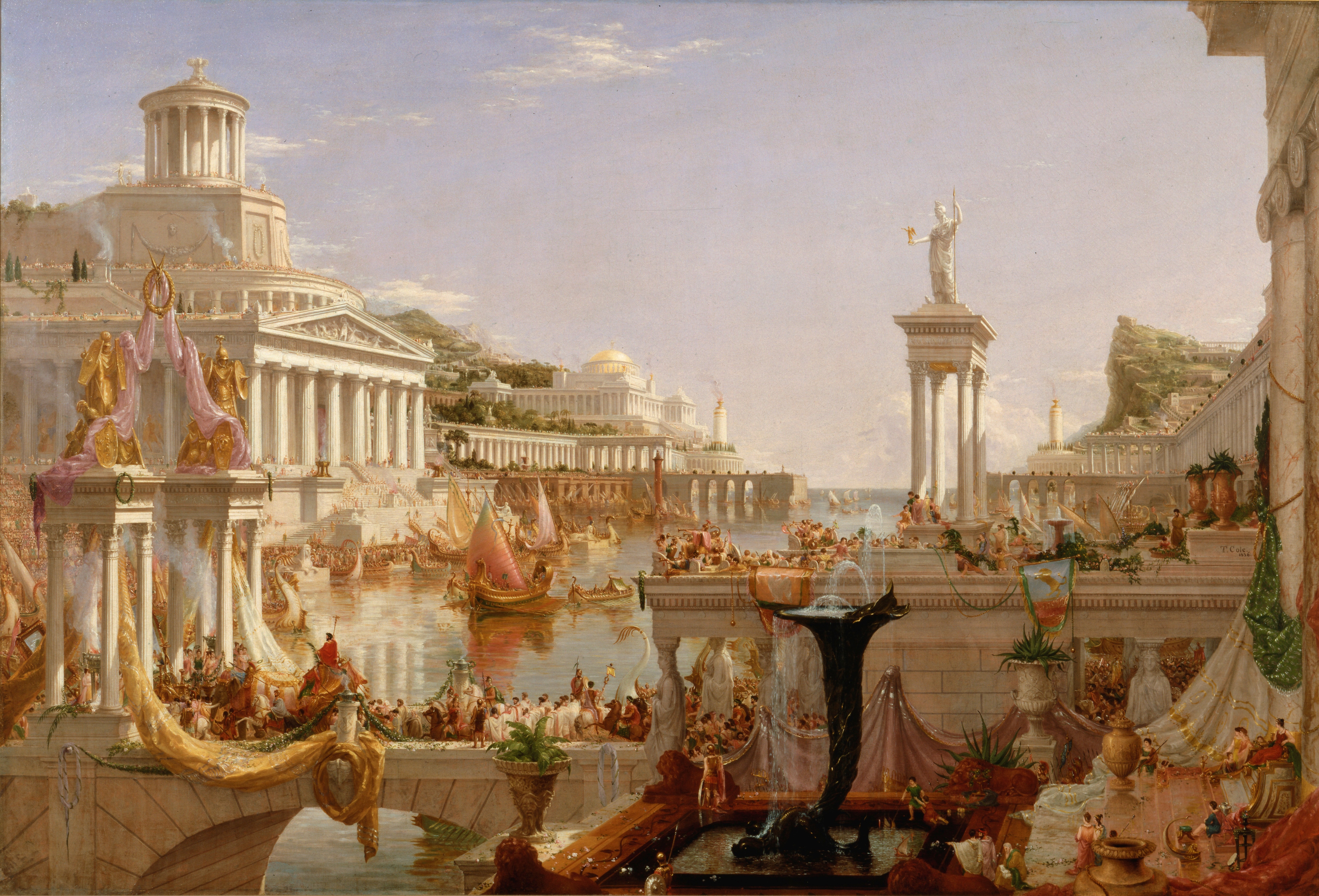
The Consummation of Empire shows a government of power, and an economy flourishing with abundance to excess.  Opulence hints at decadence. The orderly procession attending the emperor connotes a teeming population in step with the government. This is likely closer to depicting Solomon's reign than David's, since David often seemed to shun ceremony. The temple is now dwarfed by government and commercial architecture. Most link this to the height of the Roman Empire, which the architecture suggests.

The lack of reference to God does not imply that all this is sinful or evil, only that people's hearts and minds are focused elsewhere. The problem with forgetting God is that the walk away from the virtues that He commands is subtle. After the wellspring of the virtues is gone, virtues dissipate as liberty becomes license. The collapse of public and private morals ushers in the next phase. God blesses those who serve Him. Natural cause and effect bring the consequences to those who walk away.

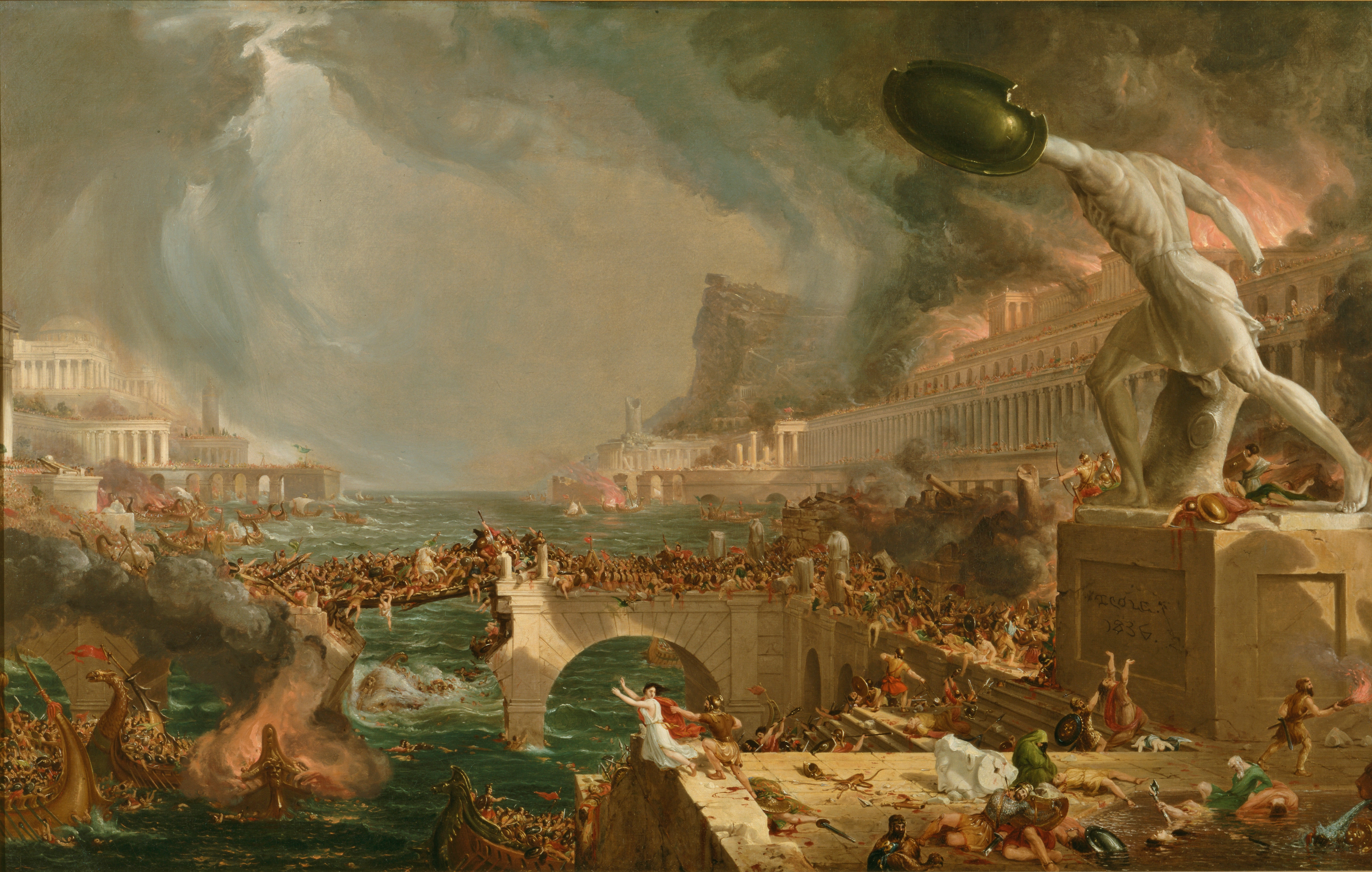
Storm clouds overshadow Destruction. How many capital cities thought unassailable have been sacked, pillaged, and plundered? Although the architecture suggests Rome in 410 AD, Rome was sacked multiple times: 387 BC, 410, 455, 546, 1084, and 1527 AD. Biblically we tend to focus on the destruction of Jerusalem by the Babylonians in 586 BC. This outcome after moral decadence is inevitable. Prophets were God's voice to plead with Israel to return to Him and His ways. The destruction of the northern kingdom in 722 BC should have been an object lesson, but a few generations later the southern kingdom followed suit. If Israel failed, can any nation succeed?

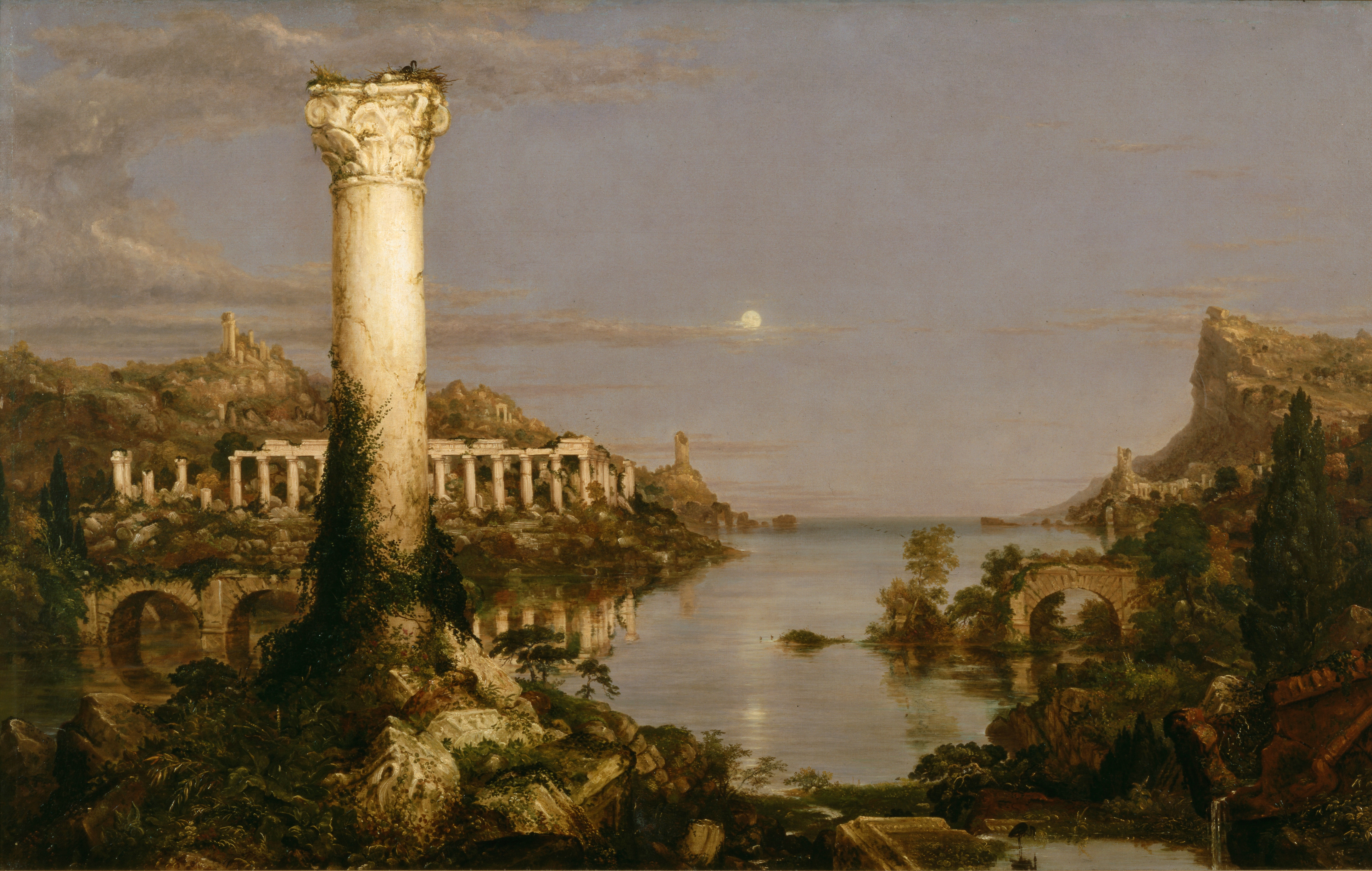
Desolation. Not even hunters or farmers. In the words of Jeremiah:
How lonely sits the city that was full of people.
She has become like a widow who once was great among the nations!
She who was a princess among the provinces has become a forced laborer!
She weeps bitterly in the night and her tears are on her cheeks.
She has none to comfort her among all her lovers.
All her friends have dealt treacherously with her; they have become her enemies.
(Lamentation 1:1-2, NASB)

Our nation was founded on the principle that a representative democracy with limited powers could best enable we the people to achieve the objectives stated in the opening sentence of the U.S. constitution. In history, other governments have rested on the divine right of kings, the power of a police state, or a claim of a mandate from God. None of these seem to be able to sustain the practice of public and private virtue in the midst of peace and prosperity. The core source of social well-being does not and cannot come from government, which can regulate external behavior (to some extent) but cannot change hearts. For all the bravado and bluster of politicians, it is the hearts of people that must win the victory over self-satisfaction, self-centeredness, self-indulgence, self-sufficiency, self-will, and self-justification.


All of this exemplifies that we are not living in the kingdom of God on a national or political plane. If we always experienced the immediate presence of Christ in our individual lives, the power of His love and holiness would inspire and empower us to live out the divine attributes He commands, even in peace and prosperity. One day, He will write His law on our hearts. (Jeremiah 31:33) But that is not going to happen on a national basis until the millennium, when the promise that every one will know the Lord will be fulfilled. (Jeremiah 31:34) Our hearts long for that day. Come Lord Jesus! Your kingdom come, Your will be done, on earth as it is in heaven!