Friday, July 21, 2017

The cyber-battle of Jericho

News media obsession with cyber meddling in the last election focuses only on the tip of the iceberg. Beneath hacking into voter registration computers are enormous cyber warfare capabilities, likely in all major nations. Disruption by cyber-criminals, who steal credit card information to sell on the dark web, encrypt hard drives for ransom, or cause other disruptions to manipulate stock prices, is only a small sample of what international cyberwar might include.

Our economy’s complete dependence on the internet, coupled with these capabilities to bring it down, risks catastrophe. Firewalls and malware scans unable to keep out cyber-thieves and cyber-data-kidnappers will collapse under the assault of state-sponsored cyberattacks. The denizens of evil have some justification for their belief that they have the upper hand, or so it appears.

When Joshua and the Israelites marched around Jericho for seven days, most likely the residents had no idea what was going on. On the seventh day after seven loops around the city, the Israelites blew their trumpets and the walls fell down. (Joshua 6:20-21) The residents of Jericho were killed (except for Rahab and her family), which probably was not what they expected. And so, when the walls of western civilization are destroyed, whether by cyber-warfare or moral collapse (whatever tools the devil plans to destroy humankind with), the kingdom that God is building in plain sight, unseen by the world, will stand. (Hebrews 12:27)


This kingdom that Christians pray frequently to come is characterized by God's love and operates according to His ways. This includes doing His will on earth, His daily provision, forgiveness by Him and by His people of each other, choices to steer clear of temptation, and His deliverance from evil. (Matthew 6:9-13) Since the Internet aggressively counters all of these values and practices, the coming cyberwar will be God's instrument to destroy it. Western "civilization" may be collateral damage, when that which can be shaken is removed and that which cannot be shaken remains.

Saturday, July 1, 2017

Healthcare superficiality

Healthcare Superficiality

What no one wants to discuss. The real challenge in the healthcare debate is the absolutely antipodal desires of more coverage and less cost.  Are these even possible to reconcile?

There seem to be a few key drivers to healthcare costs:
·    Development of new treatments to remediate health problems that were previously untreatable.
·    Extended life expectancy with increasing senior living spans, resulting from the above.
·    Unhealthy life choices.
·    Bureaucracies and infrastructure built to deliver healthcare services.

What can the government, at any level, do about these root causes?
·        It seems unlikely that the government will ever say that some treatment is not cost-effective, except comparatively.
o   For example, generic drugs are generally less costly than name-brand, but if the original developer is not allowed to recoup development costs, life-saving research will cease.
·        It is safe to aver that the government will never adopt a policy that at a certain age, an individual should be left to natural causes because we cannot afford to treat them. Hospice care is simply a result of admitting that no treatment is possible.
·        It is possible that the government might incentivize healthy lifestyles and penalize unhealthy lifestyles, but efforts so far have had marginal results.
·        The government is the very last on anyone’s list of entities that could formulate an effective policy to reduce bloated bureaucracy.

An interpretation of Psalm 84, with apology to David, King of Israel
1 How lovely are Your dwelling places, O Lord of hosts!
My soul longs and yearns to live as the Lord’s temple.
My heart and my flesh sing for joy to the living God.
3 The Holy Spirit also has found a house,
A nest for Himself, where He may bring His new creations for nurturing,
Even as I offer myself on Your altar, O Lord of hosts, My King and my God.
4 How blessed are those in whom You dwell!
They are ever praising You.
[That  is something to ponder!]
5 How blessed are those people whose strength is in You, In whose hearts are the highways to God’s kingdom.
6 Passing through the valley of Tears they make it a spring of living water;
The outpouring of the Holy Spirit covers it with blessings.
7 They go from strength to strength, Every one of them appears before God in His kingdom.
8 O Lord God of hosts, hear my prayer; Give ear, O God of Jacob!
[Let’s meditate on this prayer for a while.]
9 Behold our shield, O God, And look upon the face of those the Holy Spirit anoints.
10 For a day in Your presence is better than a thousand elsewhere.
I would rather stand for one day as God’s dwelling-place than live a long life in sin.
11 For the Lord God is a sun and shield; The Lord gives grace and glory;
No good thing does He withhold from those who walk uprightly.
12 O Lord of hosts, How blessed are those who trust in You!

Saturday, May 20, 2017

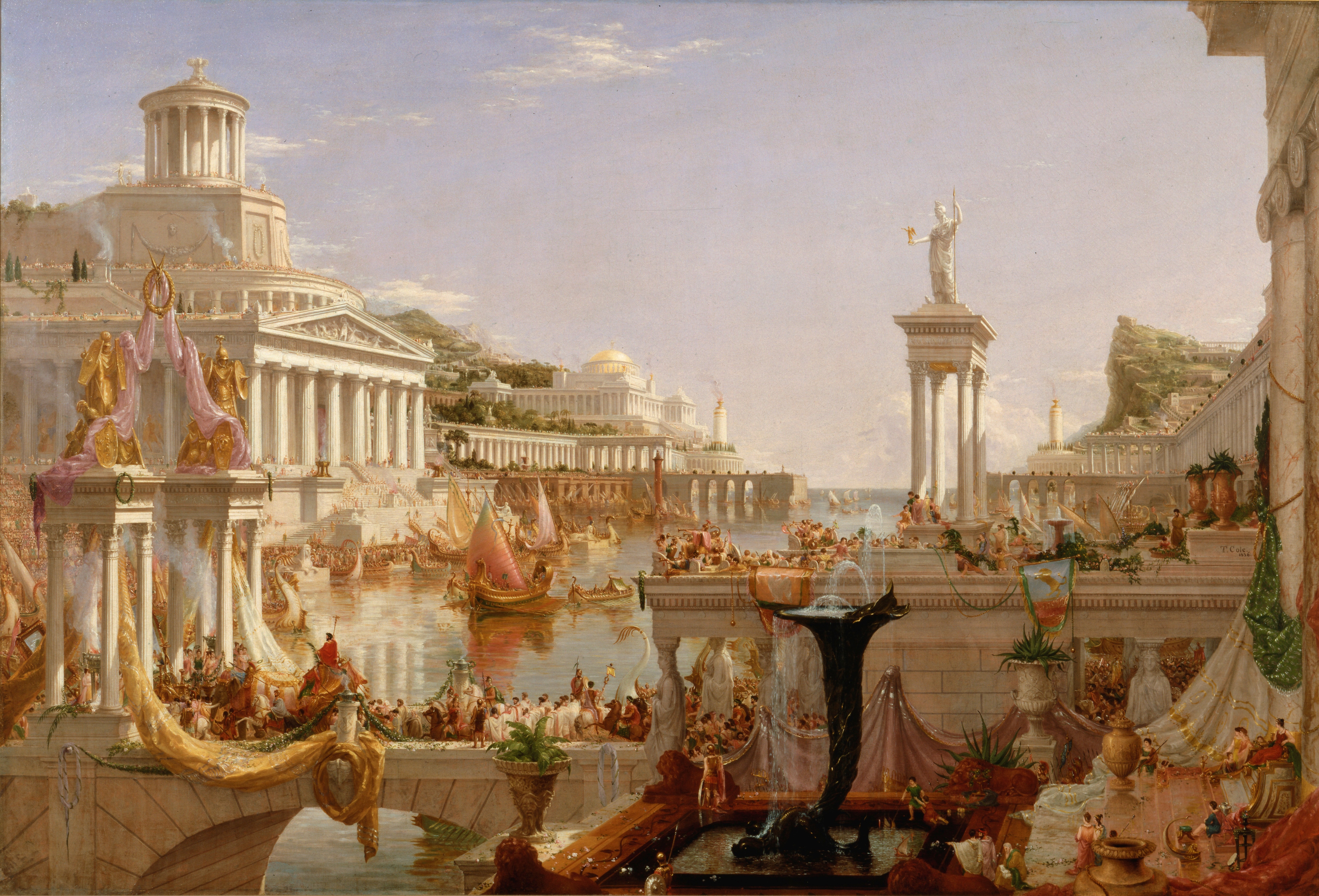
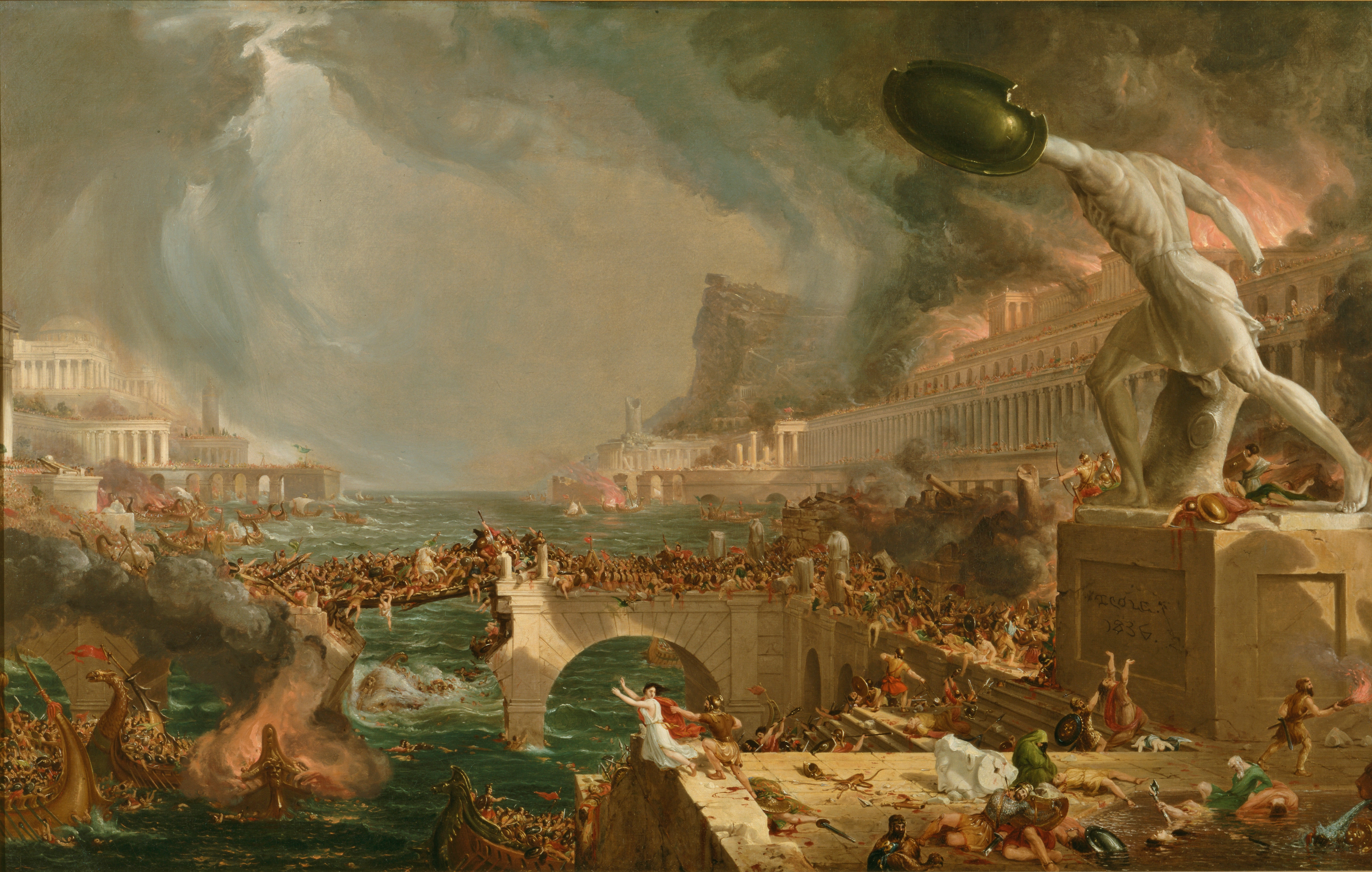
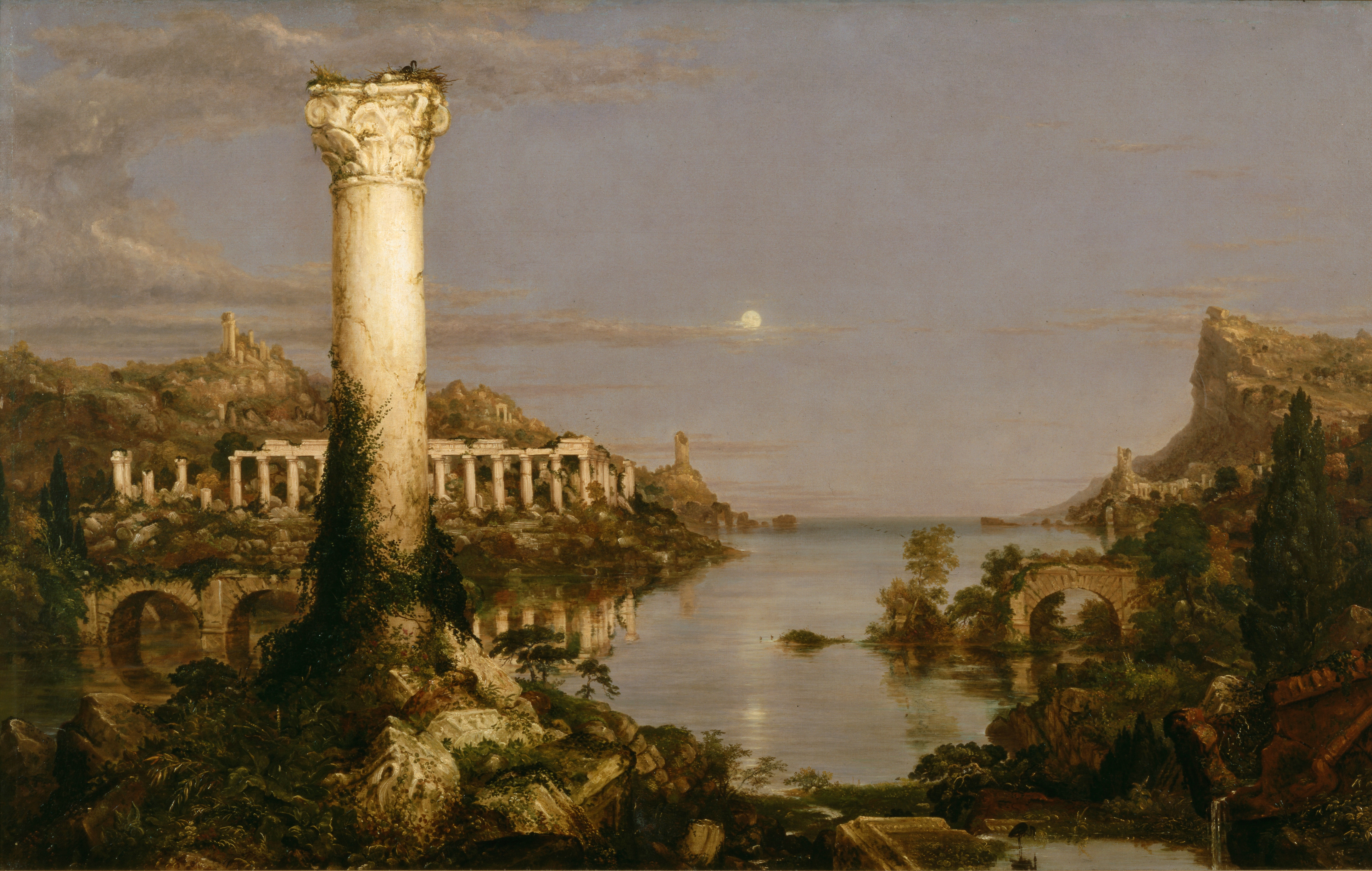
The Course of Empire - Thomas Cole

 According to Wikipedia, "a direct source of literary inspiration for The Course of Empire paintings is Byron's Childe Harold's Pilgrimage (1812–18). Cole quoted this verse, from Canto IV, in his newspaper advertisements for the series:
There is the moral of all human tales;
'Tis but the same rehearsal of the past.
First freedom and then Glory – when that fails,
Wealth, vice, corruption – barbarism at last.
And History, with all her volumes vast,
Hath but one page..."
These paintings depict human history, apart from any influence by God. History cries out, "Come Lord Jesus!"

The Savage State idealistically symbolizes the innocence of humankind in a sparsely inhabited natural habitat. But the shopworn phrase "Nature, red in tooth and claw", first penned by Alfred Lord Tennyson, suggests that life this close to nature was a continuous struggle for survival. This is not the innocence of Eden. Man (Adam) was already not walking with God in the cool of the morning.

The Pastoral State depicts farms and sheep folds and families, seemingly at peace with nature. Perhaps the structure in the distance is a temple. Does this come close to fulfilling the original directive to Adam to cultivate and keep the garden? (Genesis 2:15) The verdant meadows and relaxed stances suggest that humankind has risen above subsistence. This scene evokes idyllic peace.

Was Israel in Canaan during the rule of the judges and prophets the golden age of Israel? Every man did what was right in his own eyes. (Judges 17:6 and 21:25 ) The context of these verses suggests that few actually listened to the priests or prophets. In the first case, brazen idolatry violated the law of Moses. In the second case, tribal leaders searched the Law to find a way to avoid annihilating the tribe of Benjamin. Even in times of abundant grace from God, humankind's heart wanders.

The Consummation of Empire shows a government of power, and an economy flourishing with abundance to excess.  Opulence hints at decadence. The orderly procession attending the emperor connotes a teeming population in step with the government. This is likely closer to depicting Solomon's reign than David's, since David often seemed to shun ceremony. The temple is now dwarfed by government and commercial architecture. Most link this to the height of the Roman Empire, which the architecture suggests.

The lack of reference to God does not imply that all this is sinful or evil, only that people's hearts and minds are focused elsewhere. The problem with forgetting God is that the walk away from the virtues that He commands is subtle. After the wellspring of the virtues is gone, virtues dissipate as liberty becomes license. The collapse of public and private morals ushers in the next phase. God blesses those who serve Him. Natural cause and effect bring the consequences to those who walk away.

Storm clouds overshadow Destruction. How many capital cities thought unassailable have been sacked, pillaged, and plundered? Although the architecture suggests Rome in 410 AD, Rome was sacked multiple times: 387 BC, 410, 455, 546, 1084, and 1527 AD. Biblically we tend to focus on the destruction of Jerusalem by the Babylonians in 586 BC. This outcome after moral decadence is inevitable. Prophets were God's voice to plead with Israel to return to Him and His ways. The destruction of the northern kingdom in 722 BC should have been an object lesson, but a few generations later the southern kingdom followed suit. If Israel failed, can any nation succeed?

Desolation. Not even hunters or farmers. In the words of Jeremiah:
How lonely sits the city that was full of people.
She has become like a widow who once was great among the nations!
She who was a princess among the provinces has become a forced laborer!
She weeps bitterly in the night and her tears are on her cheeks.
She has none to comfort her among all her lovers.
All her friends have dealt treacherously with her; they have become her enemies.
(Lamentation 1:1-2, NASB)

Our nation was founded on the principle that a representative democracy with limited powers could best enable we the people to achieve the objectives stated in the opening sentence of the U.S. constitution. In history, other governments have rested on the divine right of kings, the power of a police state, or a claim of a mandate from God. None of these seem to be able to sustain the practice of public and private virtue in the midst of peace and prosperity. The core source of social well-being does not and cannot come from government, which can regulate external behavior (to some extent) but cannot change hearts. For all the bravado and bluster of politicians, it is the hearts of people that must win the victory over self-satisfaction, self-centeredness, self-indulgence, self-sufficiency, self-will, and self-justification.


All of this exemplifies that we are not living in the kingdom of God on a national or political plane. If we always experienced the immediate presence of Christ in our individual lives, the power of His love and holiness would inspire and empower us to live out the divine attributes He commands, even in peace and prosperity. One day, He will write His law on our hearts. (Jeremiah 31:33) But that is not going to happen on a national basis until the millennium, when the promise that every one will know the Lord will be fulfilled. (Jeremiah 31:34) Our hearts long for that day. Come Lord Jesus! Your kingdom come, Your will be done, on earth as it is in heaven!

Sunday, April 23, 2017

Book Review - Burning with Love for God

Paul C. DeCelles and M.F. Sparrow's guide to the spiritual exercises of St. Ignatius, Burning With Love for God, provides rich insight into the ways of God and the spiritual dimensions of love, decisions, and relationships.  Ignatius' original plan was to challenge a new believer in Christ to make a 30-day retreat to discern his calling and state in life, and specifically whether he was called by God to join the order. The framework and methods can be adapted to any believer at any stage of faith, and in any circumstance of life. The primary objective can be seen as empowering the individual, by encouraging a love-relationship with Christ, to be freed from both the bondage of sin and inordinate attachments, so that they can make decisions together with a single will.

Detailed advice addresses many different aspects of the Ignatian retreat; some have been the subject of entire books on their own. The integrated impact of all of these dimensions is intended to produce a fundamental change in the individual's life, even if not choosing to become a Jesuit. After thirty days, a person will have formed the habit of turning to Jesus and discussing with Him as a friend every situation, every decision. Sadly, in modern times, few can spend this much time in seclusion. Hence, each individual believer desiring such a lifestyle must adapt these time-proven principles to their own situation.

Three types of love - implemental, semi-personal, and personal - span the range of how people love God. Some love Him for what He does for them, such as saving, forgiving, protecting and providing for them. Some love Him because of His divine attributes, for example, His perfect love, His unblemished holiness, the beauty of His glory. The meditations' goal is to inspire in us love of God based on who we have found Him to be through personal relationship. The meditations' essence is dedicated contemplation of one of the gospel stories about Jesus, bringing them to life through visualization in our mind's eye of the scene, surroundings, actions, and words of all of the participants. The emotional impact of these visualization opens the door to an affective response to the words and actions of Christ. A colloquy establishes the habit of speaking to the Lord as a friend and hearing His voice. And thus, a personal relationship with Him is built.

The traditional religious paradigm is: God commands, we obey. This is so ingrained into our lives and church culture that to suggest the following is usually viewed as heresy. Just as a child grows from obeying his parents to an adulthood of marriage and making decisions jointly with his or her spouse, so God wants us to grow from merely obeying His commands to jointly making decisions with Him. This is not simply 'my will is to do His will', nor 'His will becomes my will', and certainly not 'I can persuade Him to do my will', but that that through the relationship, we have a joint, merged, indivisible will, because our desires are inextricably fused.

Since this ideal is rarely achieved, the authors explain three decision paradigms. A first-time decision is the direct, unmistakable word of God to our own heart and mind, without prior interaction, of His will for us. We know for certain the first time He speaks, and we make the decision. A second-time decision is based on a series of consolations and desolations, considering how the Lord is speaking to our spirit about the different aspects of a decision, and weighing them until we get a clear sense. A third-time decision is based on a rational assessment of the pros and cons of various courses of action, considered in the light of God's word and the advice of Godly counsellors. None of these models is superior, as God decides which path of decision-making He will lead us.

Other books have expounded on the Ignatian approach to the discernment of spirits. Every believer needs to test the spirits (1 John 4:1) and every believer experiences spiritual consolation and desolations. Ignatius' agere contra strategy is not the only tool for spiritual warfare, but it is effective. Try it out (reviewer's example) - every time a driver tailgates or cuts you off, pray fervently for his salvation. He likely won't start driving like an angel, but you have put a stake in the ground that Satan does not like. A much more challenging discernment is of false consolation that may confuse us, as the devil can masquerade as an angel of light. (2 Cor. 11:14) This remains one of the most difficult discernments in the Christian life, as even Ignatius wrestled with it in the well-known story of seeking the Lord's will on the exact nature of the vow of poverty that Jesuits were to live.


The bottom line is that every Christian is called to love as God loves, and we ought to strive to.

The Voyage of Life - Thomas Cole

Thomas Cole's four panel sequence, The Voyage of Life, challenges us more today than when painted in 1842.  Its timeless symbolism offers a graphic visualization of the spiritual dimension of situations and choices of life and the outcomes of decisions we make along the way.

Childhood is full of opportunity and promise. The sheltering of young children challenges caregivers to go beyond providing for and protecting their charges. Angels represent our duty to nurture children in the ways and principles of God's kingdom. Is it a stretch to read into the floral beauty on the riverbanks a reference to Eden and therein the presence of God walking with man in the cool of the morning? The challenge to caregivers is to build a relationship between children and God that is so normal that they take it as a given throughout life.

During youth - adolescence and young adulthood - individuals begin to make their own choices:  decisions about their goals, values, and lifestyle. Cole suggests that youth are drawn to a grand vision of earthy empire such as a distant castle or city in the sky. About the youth's immediate surroundings he wrote, "The scenery of the picture—its clear stream, its lofty trees, its towering mountains, its unbounded distance, and transparent atmosphere—figure forth the romantic beauty of youthful imaginings, when the mind elevates the Mean and Common into the Magnificent, before experience teaches what is the Real." But there is more than dreams versus reality in play here. Although angels are still carved on the boat (to represent the form of religion), the guardian angel has disembarked and the young man steers the helm toward the worldly vision.

How can we challenge youth with the reality that there are more important things in life than pursuing what the world offers? Many never even consider that there is an alternative. Doing things that really matter as a teen or young adult is far superior to reconsidering basic choices at a mid-life crisis. Books, such as Do Hard Things (by the Harris brothers), can challenge teens. Retreats encourage young people to make life choices that count in the long term. When young people catch a vision of things eternal, and choose to do great things to build the Kingdom of God with energy, they set a course for their lives. Sadly, Cole shows a youth headed for the world.

Manhood shows reality: Dire trials over which we have no control (the tiller is gone from the boat, the man is praying). Choices made earlier have led this sailor downriver to the rapids of life in a damaged ship. The guardian angel watches from a distant perch while three malevolent powers are much closer (the greenish triangle in the storm clouds symbolizes vices or worse). An alternative metaphor might be that the greatest victories are won in the hardest fought battles. Man at his peak of power decides the fate of his soul, if he has gone down this river. His soul may be changed by the revelation of the forces behind the worldly things he sought, and rejection of them. Or he may be broken by the shattering of his dreams. (Think of Mr. Banks in Mary Poppins.) The challenge is to recognize God behind it all, and respond to Him rather than circumstances. Manhood, mid-life, is the time for the unveiling of the forces behind the world system. If we did not turn to God in youth, God in his infinite mercy and love makes another attempt to gain our allegiance in manhood.

Old age brings the end game. Cole wrote, "The chains of corporeal existence are falling away; and already the mind has glimpses of Immortal Life." The guardian angel is close, while other angels approach. All that is left on earth is barren rock and a battered boat. What does 'finishing well' mean? In the period before death God intervenes a final time to get us to grow more into His image and likeness. Why do so many endure pain and helplessness in extended terminal illness? Perhaps when in pain we turn to Christ with fervor, resulting in an extended season of intimacy with Him. Our character continues to be shaped up to the time of death, so God has one final season for us. For many, God brings crises before terminal illness sets in. We finish well if we pass these tests, but even if we fail, God is refining our soul.

The common theme in this voyage is whether and how we respond to God's challenges. Will we work for Him to do things that matter for eternity, for building His kingdom, in a world that opposes and tries to lure us away from that course? How will we respond to His challenge to live like Jesus, in the sense of doing the Father's will? Guardian angels are part of God's economy, but it is our decisions throughout life that count for eternity.

The original paintings are at the National Gallery of Art.

Saturday, April 15, 2017

Holy week and Easter

The events of passion week and following Christ's resurrection vividly illustrate the stark contrast between the ways of the world and the kingdom of God.

The four gospels record different aspects of the conspiracy, arrest, trial, and crucifixion of Jesus. The political intrigue, the suborning of Judas' betrayal, arrest of Jesus, show trials, and collusion between the priests and the Roman governor are all simply demonstrations of how the world-system governs. It is ironic that the priests had the Law of Moses, the law as ordained by angels (Gal 3:19), but bought into the ways of the world, and so opened the door to the ruler of this world. God did not simply allow this to happen as a means to accomplish redemption. He used it as a demonstration of the utter antipathy between His kingdom and the world. This was the inevitable outcome of the confrontation of the world-system by God Himself.

The manner in which Jesus revealed Himself following His resurrection demonstrates the completely opposite nature of the ways of God. We might think that God's power manifested in raising Jesus from the dead was like a volcanic eruption, perhaps akin to Mount St. Helens or Krakatoa. But when Jesus rose, He quietly left the tomb, and angels rolled away the stone so the disciples could get in to see that He was not there. When Mary Magdalene came to the garden, He spoke quietly to her but she did not recognize Him until He spoke her name. (John 20:14-17) The disciples on the Emmaus road likewise talked with Him at length without their recognizing Him or His deity.  (Luke 24:13-31) Although Jesus subsequently revealed Himself to as many as five hundred at one time (1 Corinthians 15:6) the only work of power that is recorded is His ascension. God did not manifest His power until Pentecost. Even in the days of Elijah, God was not in the great wind, earthquake, or fire, but spoke to the prophet in a gentle blowing. (1 Kings 19:11-13)


When we consider the power shown in creating the universe ex nihlo, and setting into place the universal principle of causality, our minds are unable to grasp how God can be outside and not subject to the law of cause and effect. He says, "I am that I am." His very essence is perfect holiness and perfect love. Yet in showing Himself to us He seems almost shy, deferential, and definitely low key. Power politics, governance, and society, no matter how noble or well-intentioned, cannot escape the need to show off and bluster.  At their heart, they are insecure in exercising position as unworthy usurpers. God needs no such displays and so does not coerce or even overwhelm. He woos; He pleads; He speaks softly and gently. Would that we hear His voice and respond, tuning out the din of the world-system and rejecting its ways.

Sunday, April 2, 2017

The Missing Foundations of Foreign Policy

Does our foreign policy reflect the tenet that a nation's governance rests on the foundation of its society? In a democracy, the consent of the governed results from the choices made by voters based on their values and participation. Authoritarian regimes rule because they control and usually intimidate their subjects, overlaid on a variety of social dysfunctions. In the West, we highly value democracy as an end in itself, and promote its adoption in other nations. 'Benevolent dictatorships' usually aren't. Egomaniacal dictators tend to destabilize international relations.

Unfortunately, competition between major nations played out by surrogates in smaller third world nations overlays international relations. This history goes back at least as far as the 18th century, most likely far further. European colonialism and imperialism created a large number of theaters as the major European powers sought to advance their economic interests. US-USSR competition in the 20th century through many administrations of both parties did not hesitate to provide military support to factions within various countries to achieve political advantage. The Bay of Pigs fiasco and support to Afghanistan insurgents in the 1980's immediately leap to mind. Contrast these with the Marshall Plan and the Peace Corps.

Herein lies an object lesson. Support to the Taliban and Al Qaida in the 1980's morphed into existential threats to Western civilization in the current decade. By this I mean that even if radical terrorist groups cannot destroy our governmental institutions, our response to their threat can so change our social fabric that we lose the very values we prize. Threats from groups we supported thirty years ago! The adage that 'the enemy of my enemy is my friend' is sometimes used to rationalize strange bedfellows. But they never were our friends; at most they were co-belligerents. Despite the ultimate collapse of the USSR political structure, the world does not appear to be a safer or better place.

The kingdom of God is not built this way. Apart from the futility of military effort and short-lived fruits of victory, what God seeks can only be achieved through His prescribed methods. Jesus was very direct: "Those who live by the sword shall perish by the sword."(Matthew 26:52) "Go ye into all the world and preach the Gospel." (Matthew 28:19) Jesus here (and elsewhere) articulated that His kingdom only comes into being through being built into peoples' lives. What does this mean?

The Gospel begins with the good news that Jesus died on the cross to save us from our sins. This includes both the penalty for and the power of our own, personally chosen and executed sins. God's purpose is integral to His action. He enters into an intimate, personal relationship with each believer infused with love. As this relationship develops, Jesus works in His beloved's life to free him or her from sin and bless them with all of the fruits that flow from the Holy Spirit. He also cares and provides for them in many practical ways, as He promised in Matthew 6:33. He also blesses the believer with the fellowship of kindred souls, giving the command that they wash each other’s feet. (John 13:14) This is a snapshot of the kingdom of God.

The loss of a Spiritual foundation for foreign policy presents a fundamental problem to the West. During the 19th century, the London Missionary Society sent missionaries all over the world. The foreign policy of the British Empire, despite being motivated by mercantilism, provided the infrastructure for this incredible enterprise. As just one example, slavery was abolished in the British Empire in 1833, well before the US civil war, based on explicitly Christian mores. Politically correct policy in our day dares not invoke any Christian, or even spiritual, foundation.

Effective long-term foreign policy strategy has yet to be articulated, by this or any recent administration. Ronald Reagan may have erred in supporting the Mujahadeen, but we have no basis for building into the lives and cultures of nations around the world values that would provide a foundation for freedom and democracy. We desperately need such a strategy. There will likely be a one or two generation lag in seeing fruit, but this is the only reasonable approach to long term international stability.